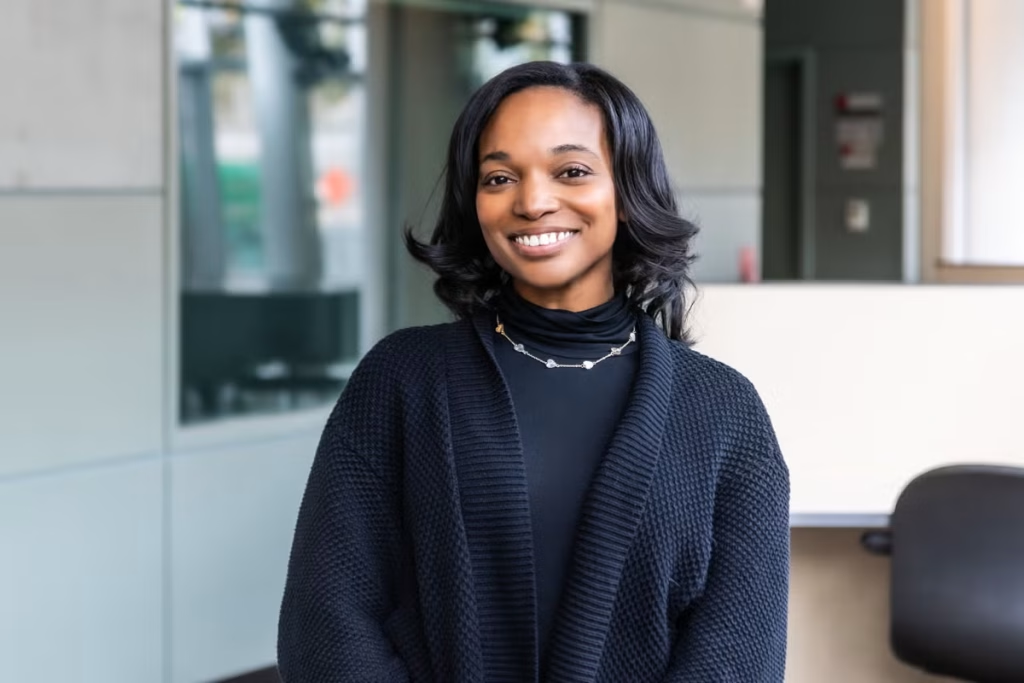
On March 23, Sophia Rodriguez, associate professor of educational policy and leadership and sociology of education at New York University, visited campus to discuss her recent work, “Undocumented in the U.S. South: How Youth Navigate Racialization in Policy and School Contexts.” Published in Aug. 2025, the book details her findings from ethnographic research about the impact of anti-immigration legislation on undocumented K-12 students’ sense of belonging. Rodriguez’s research hopes to inspire reform in both public education policy and pedagogical methods, aiming to make public schools more supportive environments for immigrant students.
Rodriguez started the lecture by detailing her upbringing as a first-generation immigrant and her career in education. During her time as an Assessment for Learning (AFL) and English Language Arts (ELA) teacher in the Bronx and Chicago, she taught students from immigrant families — experiences that ultimately inspired her to direct her personal passion for immigrant rights toward the education system.
Rodriguez’s research methodology, which incorporates interviews and focus group work, has led her to build long-term relationships with the K-12 students whose experiences she studies. When describing her experience as an educator, said, “It’s a real commitment we make, depending on the type of work we do. [Due to] the privileges that we may have as citizens, I’m in a different position right now than even several of my Ph.D students who are not able to come to our conferences this year because they’re afraid that ICE is now at the airport. So, these are things that are on my mind on a daily and nightly basis.”
As she began her research ten years ago, Rodriguez remained keenly aware of the national dialogue surrounding immigration and education. Alongside a graduate student, she examined legislation records from the previous fifteen years on a state-by-state basis for indicators of hostile attitudes towards immigrants. Her search used the keywords “immigration, immigrant … alien, foreigner.” For her long-term study, she followed the lives of hundreds of students and staff members at two public schools in South Carolina.
The “macro” section of her research, which constitutes the first part of her book, provided the context for why immigrant students felt unwelcome and excluded in their schools. South Carolina piqued Rodriguez’s interest because, as the neighborhood was more “dispersed,” it lacked educational equity relative to some other states, and had a low Latin-American population.
She went on to explain that the lack of a community for Latin-American students led them to feel “very much under surveillance” in the classroom and in their neighborhoods.
“They talked about their families having to go to the grocery store at certain times of the day or not walk to school by themselves. There were instances where they shared a lot about what they were noticing in their community as a form of policing and immigration surveillance that they experienced,” Rodriguez said.
The “meso,” or middle section of her book, described how these issues appeared in the school setting. Rodriguez drew from the interactions between students, teachers, and staff members to underscore this heightened level of scrutiny. Educators and other adults affiliated with the schools would sometimes borrow rhetoric from federal anti-immigration policy to humiliate students. Rodriguez cited a time when a teacher told a student, “This is why they’re building a wall” in response to their poor behavior. She also cites a question from a teacher to her Mexican student, who was a U.S. citizen, “Wait, they let you back in [to the U.S.]?”
Another challenge that Hispanic students encounter is being pulled out of class to help staff members carry out conversations with language barriers. Some teachers argued that it was beneficial for the students to be translating instead of learning in the classrooms because it was teaching them to be “helpful.” Nevertheless, the process proved to be disruptive for the student being pulled and their classmates. A solution to this problem would be providing Language Learners, who could alleviate the use of students’ time and effort in translating for their teachers. Introducing Language Learners into the classroom is controversial because some believe that they are too costly for the districts. Rodriguez points out that there are little to no studies that support the widespread notion that language learners are too much of a financial burden for schools.
The concluding section of the book, titled “Micro,” explains how these experiences shaped the students’ racialized sense of self and identity. Rodriguez points out that, in her opinion, the students often possessed a more nuanced understanding of how paradoxical anti-immigration rhetoric is.
“One of the kids said, ‘The state wants Hispanics to do their work for them, but we can’t go to school without being afraid.’ This was something that I wrote about a lot in the policy chapter because kids were thinking, ‘They’re recruiting workers to be here, our parents are migrant farmers, our parents are undocumented workers. We’re clearly contributing locally to the economy, but then also being criminalized.’”
With these experiences in mind, Rodriguez emphasized the importance of amplifying student voices. Within the two schools she studied, there were virtually no avenues for the students to voice their grievances with the school or with the political climate.
Rodriguez asserts that there are “different types of interventions for kids to participate in the work of the school. [That’s] designing a curriculum that’s related to their social and emotional health, their trauma, and sharing that with educators in the building.”
At the end of her lecture, and throughout the Q&A segment, Rodriguez explained her research approach going forward. Now, she is working more directly with school districts with the hopes of enacting more direct changes. One of the biggest challenges she faces is time: “Research takes longer than policy needs to.”
Recently, Rodriguez submitted a statement in support of Plyler v. DOE in the face of pushback from Tennessee and other Republican states. Plyler v. DOE is the landmark Supreme Court case that allows for undocumented K-12 students to receive a public education.
“Eroding it would be harmful and damaging to all kids. It’s also the cornerstone of our public education that we want kids to go to public school, have a shared experience for democracy, be civically engaged, and learn critical skills to function in a society.”