“KFC has apologised after sending a promotional message to customers in Germany, urging them to commemorate Kristallnacht with cheesy chicken.” I remember reading this 2022 article from the BBC in history class. How did this happen? Well, KFC blamed a bot using a calendar to send automated push notifications to customers, regarding deals related to important dates in German history.
From the title, you might think that I am going to discuss the 1977 hijacking of the “Landshut” or some other attack from the German Autumn — the period from September to October, 1977 that saw the West German government pushed to the brink by RAF terrorists. However, I am actually referring to the 9th of November (Europeans write the date dd.mm.yyyy), a very portentous date in German history. This day has seen everything from the country’s greatest jubilation, to one of its most sinister events. On this day in 1848, the popular democrat and revolutionary Robert Blum was executed by Austrian forces. This was after the retaking of Vienna, which ended his bid for a German republic. 70 years later, with WWI clearly lost, Kaiser Wilhelm II’s abdication would be announced by his Reichskanzler Max von Baden on the 9th of November, 1918. So ended the Second Reich. That same day, Philipp Scheidemann would announce the birth of the German republic for which Blum was martyred. However, this first German democracy would be challenged on the 8th and 9th of November, 1923, when the Hitler-Ludendorff-Putsch failed to topple the government of Gustav Stresemann. The Nazis would take power in 1933, and on the 9th of November, 1938, their persecution of German Jews would accelerate with Reichspogromnacht, which saw Jewish businesses, homes, and synagogues destroyed.
After WWII, 9.11. would be the date of some key events in West and East German politics, including the death of Holger Meins on hunger strike in 1974. However, the final major event, and the event that this date is chiefly celebrated for, occurred in 1989, when a series of bureaucratic errors led to the Berlin Wall being opened. The little-known story of how Germany’s divided capital was repaired, involves a mid-level administrator, who misunderstood a press release and took unsanctioned action to prevent the depopulation of East Germany, a Politburo member who didn’t read this statement before speaking to the media, and a Stasi officer who decided to let the resulting mass of East Berliners who mobbed his checkpoint through. I encourage any readers to investigate this story for themselves. It would subsequently be ripped to the ground by jubilant Berliners, with the 9th of November, 1989 coming to be known as the “Mauerfall” among Germans.
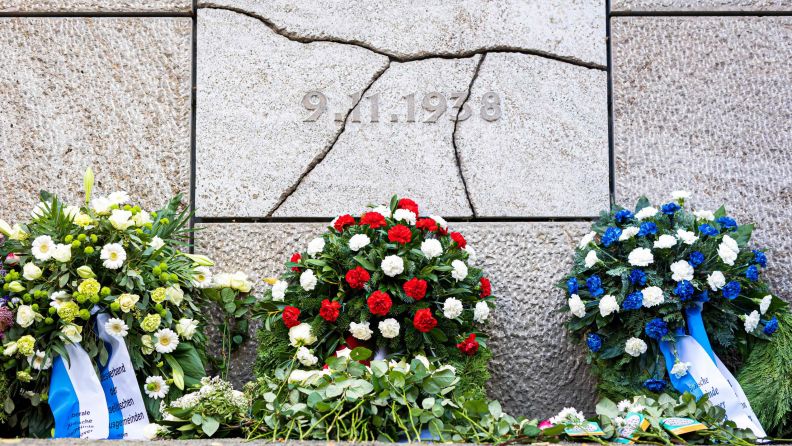
As you can see, “the German Date,” as it was termed by Wolfgang Brenner, is deeply important to modern German history. However, it is very hard to commemorate. Would you celebrate the throughline of the fight for democracy, beginning with the martyr, Robert Blum, moving onto the declaration of the first German republic and ending in the symbolic defeat of totalitarianism? Would you sneak the Beer Hall Putsch in there, as a temporary defeat of fascism, or view it as a precursor of what was to come, and thus regret it? If you were to celebrate this day, in any capacity, would you be disrespecting those 6 million Jewish victims of the Holocaust, with Kristallnacht being seen as a major escalation in the Nazis’ persecution of German Jews? The German government has attempted to solve this conundrum by acknowledging 9.11. as “Germany’s Day of Destiny,” a day of remembrance rather than a public holiday. While the fall of the Berlin Wall is not forgotten on Nov. 9, the country’s national day, The Day of German Unity, is celebrated on Oct. 3 to mark the date when, in 1990, German reunification was officially completed. This date is without the baggage of the 9th of November. The respectful effort to acknowledge the duality of 9.11. in Germany history is exemplified by the picture at the head of the “9th of November” page on the German government’s website: a commemoration of Reichspogromnacht.
This approach to commemoration of the German 9.11. is a product of years of policy adjustments in response to criticism from all sides, as well as reactions to ever-changing circumstances. For example, in 2018, the German government chose to emphasise remembrance of Kristallnacht. They did this because of 2018’s being the 80th anniversary of the crime and in response to an attack on a synagogue in Pittsburgh. This prompted people around the world to acknowledge that, in the words of then Israeli Diaspora Affairs Minister Naftali Bennett, “[antisemitism] is not a thing of the past, nor a chapter in the history books. It is a very real threat.”
On the polar opposite side of the debate, however, you have the calls for a “line to be drawn” under the history of Nazism. This perspective has been around since the early 1950s and is currently represented by the AfD, Germany’s most popular party. Those who believe that Germany’s efforts to remember its Nazi past are unnecessary and self-flagellating would rather see the 9th of November celebrated, with the emphasis placed on the glorious history of Germany’s multigenerational fight for democracy, rather than on the stain of Kristallnacht. Historian Timothy Snyder has warned of the dangers inherent in forgetting Germany’s past at a time when “history is needed more than ever” to prevent repeating the mistakes of the past.
However, the debate surrounding the commemoration of the 9th of November is not a simple choice between focusing on the antisemitic crimes and turning our backs on the history of Nazism. There is a third way, which would see the day made a national holiday that acknowledges the positive aspects of its history, which are currently downplayed for fear of overshadowing the events of 1938.
Simultaneously, it is important to curb the jubilation that may be associated with a celebration of the Mauerfall. Historian Wolfgang Niess argues that this necessary nuance is what would make the 9th of November a perfect national holiday. With its highs and lows, this day of providence for the German people exemplifies Germany’s history in its truest form, contradictions and all. Niess goes on to argue that proper commemoration of the 9th of November could help to foster “republikanische Leidenshaft,” or republican passion. According to Niess’ vision, such a proper commemoration would include a mandatory project day, held by all of the country’s schools to encourage German children to investigate the full scope of their national past.
On the other hand, historian Thomas Weber argues that while many of the events of November 9th deserve to be remembered, to connect them through a sort of historical master narrative is inappropriate. He sees Niess’ proposal as imbuing 9.11. with an undue importance as representing the scope of modern German history. In fact, he and Heidi Tworek have suggested that such a narrative would be built on Nazi propaganda, which framed 9.11. as a fateful day to mobilize the German people in an attempt to reverse the democratisation of 1918.
It is not for me to pass judgement on the correct course of action, with respect to the commemoration or remembrance or celebration of the German Date. However, it is an interesting thing to consider. What a strange coincidence it is that all of these monumental events fell on the same date. It’s almost a shame that they did. To celebrate the fall of the Berlin Wall or to remember the Holocaust shouldn’t be a choice. But one day a year, it seems like it is.