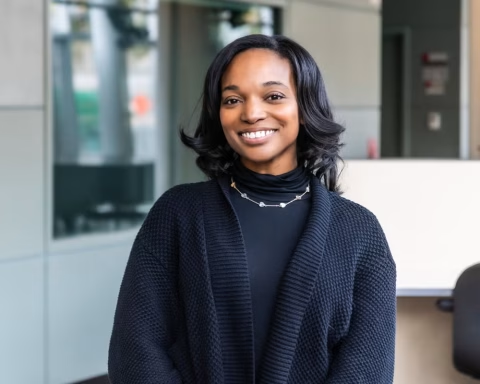
Arlie Russell Hochschild ’62 H’93 is a professor emerita in the department of sociology at the University of California, Berkeley. Hochschild graduated from Swarthmore in 1962 before earning her M.A. and Ph.D in sociology at Berkeley, where she has spent the majority of her career. She served as a Lang Visiting Professor at Swarthmore in the fall of 1992 and was awarded an honorary degree from the college the following year. Her work has focused on the sociology of emotion in relation to family, labor, and, lately, the rise of the right.
Her most recent two books, “Strangers in their Own Land” and “Stolen Pride,” released in 2016 and 2024, respectively, brought her to rural America to talk with small-town communities and examine the rise of the Trump-era right wing. To discuss this work and more, she spoke with The Phoenix on April 7. A transcript of the conversation, edited for clarity, is below.
Daniel Perrin: First of all, thank you so much for talking with me today. I want to begin by letting you introduce yourself to readers who might not be familiar with your work. In that vein, I’m curious: your earlier academic work is focused on the sociology of emotion as, at least partially, a socially influenced phenomenon, but your most recent work seems to be more public-facing and “political” in the mainstream sense of the word. What do you understand to be the through line of your career as a thinker and a writer?
Arlie Russell Hochschild: First of all, hi to Swarthmore. I have very fond feelings for Swarthmore. When I went there, there was no department of sociology, and no courses in it. So I majored in economics and political science and history — a joint major. But when I discovered that there were places you could study this thing called sociology, I took a deep dive into it at UC Berkeley, where there was a very fine department. Ten books later, I am still applying this thing to my work.
In my last two books, I’m very much concerned with the rise of the right. One book, “Strangers in Their Own Land,” was based in a very pre-MAGA (and now turned to MAGA) area of Lake Charles, Louisiana. This is a very poor state — the second poorest in the country — that turned from mainstream Republican to hard MAGA right. This last book, “Stolen Pride,” is based in the second-poorest congressional district — in Appalachia — in the country, and the whitest. So I’ve taken two kinds of close up looks to try and study what I call emotional capture by a right wing party: How does this happen? You have a charismatic leader, but what’s charismatic about charisma?
Very often, the talk among Democrats or progressives is about rational policies and how the right are misguided to think they have answers to the real problems. What I am arguing in these last two books, but really in all my books, is that we have to think rationally about emotion: that the real logic is on that track. In other words, it’s a call for us not to say, “Well, let’s get emotion out of the way so we can study the truth.” No. It’s to say, “We have to think rationally about emotions to know the truth.” And so it’s a call, really, for us all to become “bilingual,” in the sense that we can read rational discourse, but we also read emotional discourse.
So in this, if I were to put into a sentence what I’ve discovered with these last two books, it is that if we go back three decades, globalization created its winners and losers, and I think what’s really important are the losers. That is, if you look at white, non-college educated — that’s blue-collar class — they took a hit. There was a downward mobility of that entire sector in both absolute and relative terms. In other words, its income and prospects are downwardly headed, and in its most extreme form, you see more and more people living alone, parents not in touch with their children, there’s kind of a social desert effect, and diseases of despair.
The book is advocating for a change of thinking and focus for a lot of people on the left. As a main point, it says that loss – not absolute deprivation, but loss – is the thing to keep our mind on. A social psychologist who does very important work, Daniel Kahneman, a Nobel Prize winner, found that human beings will pay twice as much to get back what we once had as we would pay to get something we really want but never had. This idea of loss aversion has been applied primarily in the economic realm, but I’m applying it in the emotional realm. What do we feel when faced with loss? “Everybody else is doing better, and we’re going down and they’re going up,” and compared to their dads, guys are doing worse. So loss, I think, is what we should keep an eye on: how it makes us feel. And I argue in the last book, it’s depression, loss of identity, and also shame.
I’ve argued in this last book that we have to look at two things. First is the predisposition to feel some response to loss, and I think that’s the most important thing. First, we tend to look at the charismatic “Magic Man” as someone who steals this constituency, but we should look at the predisposition of looking very hard for an answer to their loss aversion. Then, I think they became emotionally captured. That’s why this thing is hard to shift, and that capture comes in three stages:
One is an appeal of recognition: “I see who you are. I can understand what you’re going through.” I talked to a man who had been fired from his coal mine and got injured. He went to get pain relief, became addicted, lost his family, lost custody with children, and hit the bottom. Then in the recovery room, he saw Donald Trump in 2016 saying, “I’m going to bring that coal. America’s so far down. We’ve been shamed. Look how bad we are, but I’m going to make America great again.” This man said to me, “I knew Donald Trump was lying about bringing back coal, but I felt like he saw who I was.” Let’s not pass over that. That’s an emotional statement that turns out to be huge, and the Democrats weren’t doing this.
The second moment in emotional capture is when Trump makes up a narrative that shifts shame to blame. [Trump] says, “Oh, you’re ashamed, you’ve lost your pride. It didn’t just go away — who took it? I will recover it for you. I will be the Robin Hood of your pride. It’s been stolen, and I’ll get it back.” That, I think, is the primary narrative that pulls people out of the doldrums and focuses them on an enemy.
I think the third and final way of nailing in that narrative is a four-moment anti-shaming ritual, and you can see logic in it when thinking emotionally. It goes like this. Moment one: Donald Trump says something transgressive. Those have been getting more extreme, but in an example, he says, “Haitian immigrants are eating their cats and dogs.” Moment two: the punditry shames Donald Trump. “You can’t say that. It’s not true. It’s a bad thing. You’re lying.” So the punditry shames him. Democrats shame him. Politicians shame him. Comedians shame him. Moment three: Donald Trump becomes the victim of the shamers. He says, “Look how they’re putting me down. Look at the terrible things they’re saying. They even want to indict me. You, my followers, don’t you know what it’s like to be put down and you don’t deserve it. It’s terrible. Doesn’t it hurt?” Here, he’s being like Jesus, “I will take on myself the burden of your shame, so you should feel a little lighter. It’s on me.” That doesn’t last long, but he does say, “they are doing to me what they want to do to you.” Moment four is retribution. “I’ll get back at them for you. I am your retribution.”
The Democrats have been listening to moment one and two, tuning in to his crazy statements and put-downs, and the Republicans have been listening closely to three and four. I think that we’ve got a call to recognition, we’ve got a dominant, evocative narrative constantly repeated like mad, and then every four months — the actual details of this anti-shaming ritual differ from time to time — but if you are being ‘bilingual’ and listening to the emotional subtext and catching the logic of it, this is what’s nailing it in. This is what they’re tuning into. So that’s why I think developing this ‘bilinguality’ is important for us to know what’s going on and then to decide a strategy for it.
DP: Your earlier work introduces the notion of “emotion work” as the tangible and material labor of care. In recent years, our social fabric seems to have been upheaved in many ways by the lingering effects of the COVID pandemic, among other kinds of larger societal shocks. How do you think COVID and other recent shocks have changed emotion work in the private and or public sphere?
ARH: Emotional labor, I think, is an idea that can be applied in many realms. Initially, I wrote a book called “The Managed Heart: Commercialization of Human Feeling,” and I was looking at the effect of capitalism on emotions. I went to a Delta airline stewardess training program in Atlanta, Georgia to see how young women were being trained to be, in a way, nicer than natural, and really think of people in the cabin as as neighbors and friends in their living room, visualizing what they had to in order to be as nice as they were paid to be. And there are debt collectors on the other end who had to collect on the goods or services sold and, if necessary, bear down and be harder. And I thought of that as the “toe and heel” of capitalism.
But now, I’m applying what was a set of ideas and attunement applied to the economy, to politics, but with emotional labor in both realms. So these flight attendants were doing emotional labor. In COVID, people were dealing with isolation and depression, I think, turning inward and experiencing a loss of identity is especially hard on those teenagers whose identity is at a stage of forming and is vulnerable in those times. There’s kind of a stiff upper lip, but at the same time, what you’re really managing is turmoil and uncertainty and fear. Fear especially of disconnection.
Yesterday, I got an email from someone who was not a social worker and not a sociologist. He studied organizations, and he said he used my work on emotional labor to help hospitals in Palestine. I’m about to Zoom with him on Friday. I’ve never met this man before, but I can tell you, I was thrilled that he found some use of my work in that context.
DP: Going back to some of the subjects of “Stolen Pride” and “Strangers in their Own Lands,” in all of these discussions of the “stolen pride” of blue-collar America, there’s an understandable sense of nostalgia for the prosperity of the post-war economic boom. How do you balance the need to take that nostalgia seriously while also appreciating the risks that come with a very nostalgic, backward-looking, and liability-focused politics?
ARH: I think it is hugely important for us to focus on the challenges that face us now, and in fact, those challenges are getting worse, almost by the week, by the day. As you and I speak here under the situation in which our president has actually threatened to commit war crimes and obliterate the whole society of Iran. So at the moment, we’re forced to look at that crisis and the fact that this political crisis is on sped-up time. In other words, Donald Trump’s strategy, I think, is to overwhelm us, to go so fast that we can’t catch up. And democracy is on slow time. It operates differently, but that doesn’t mean it’s not there for people of good heart to act together.
In a way, though, your question really got to, “What do we do now?” We can’t just be sympathetic with the desire for yesterday. No, I don’t think we have that time. I’m actually an optimistic person, I think we can figure out a way out of this huge political crisis. But I think it could get worse before it gets better, and that’s because the AI shock that I see coming could do to the white collar class, what my last book, “Stolen Pride” shows happened to blue collar, rural coal miners and their kids and grandkids.
The through line is loss and loss aversion. I didn’t start out with that idea, but after talking to people, I came home to my office and kept thinking about loss aversion. We may be up for more loss aversion. And loss aversion makes you look back to yesterday: “Gosh, things were better then. I’d rather have back what I once had and get a new thing I never did have.” So I think we have to be mindful of that and not just say, “Oh, there are people in need worse off than us, we must help them.” That’s my more fundamental instinct, and I think people on the left share that with me, but the danger is coming from elsewhere. We have to attune ourselves to that and build a great big dream that’s incorporative and speaks to anxieties set off by loss.
DP: Unlike many academics who have studied these topics, you’ve spent a lot of time thinking about a more affirmative vision of what can be done now to address these problems. It seems that you’ve concluded that Democrats and all leaders need to embrace policies and projects that reinvigorate civic life and focus on those kinds of responses to the everyday problems that people have. Can you say a little bit more about what that looks like, both in these communities that you’ve engaged with in Kentucky and Louisiana, and in places like the big coastal cities and their suburbs?
ARH: I think what we really need to do is to create thousands of what I called in the book “empathy bridges” left to right, and they can be within red bubbles, within blue bubbles, and across red and blue bubbles everywhere.
One study has shown that people on the left are more likely to break off a conversation with someone who says something they don’t believe than are conservatives. That’s our bad. There’s another study that indicates that conservatives are more likely to open up and reduce the political temperature if they’re seeing somebody across the table, if it’s one-to-one personal conversations. That’s not what usually happens on the left; we’re too into email and cyberized connection. “We don’t need to meet. We just need to Zoom. We just need to email.” Well, not for the right: they’re rural, and actually people in rural areas are a little more used to getting along, listening to each other. So, that’s a problem, and I think the left has to get busy, it has to say, “Okay, my bad. Let’s start.”
I had a wonderful experience a few months ago that all the people in my last book wanted to get to know each other, and so they got together, and one man got the idea, not of a dialog, but of a local get-together. Some of the people were Trump voters, some were not. It was fantastic. I think that should be the model across the country: civil discourse and respectful talk across differences — and I’m hoping my books help that along.
DP: In your interview with The New York Times, you and David Leonhardt talked about the possibility of a third party or similar organization to focus on projects that respond to daily needs and to capture some of the resentment that the communities like the ones that you’ve studied have towards the conventional way things have been done. At the same time, though, it seems like there’s quite a bit of resentment, both in communities like the ones in Kentucky and Louisiana, and in big cities on the coasts, at the uninspiring nature of status quo, moderate politics that a third party might have. There’s a real desire for fresh ways of thinking. How do you balance these two pressures when thinking about the future of a more positive politics?
ARH: First, I think we have to not just look at politics in a rational way. Look at a whole deep story that underlies each side. The deep story of Republicans and of MAGA is one of loss and subversion, so a first order of business for people who are not MAGA is to speak to that and ask what’s been lost.
But aren’t we losing something right now called democracy? And can’t we get together on that one? To appeal to what’s really going on for the other side, don’t just say “you stupid hillbilly, you uneducated Southerners.” That is toxic to what we have to do to reach across. There are bridge builders in red states and red cities, and blue bridge builders need to get together with those red bridge builders. So that needs to happen.
I’ll give you a short example. I had a man who read “Strangers in their Own Land.” He said, “I have read your book, and you describe me. You describe the people I serve as an evangelical minister,” and he said, “I felt heard, thank you for your book.” Imagine his surprise to receive good news from, of all places in the country, Berkeley, California. So I laughed, but I wrote him back. “Thank you for your kind words. Signing off your friend from Berkeley, California.” We became friends, and now we’re both board members on something called The American Exchange Experiment, which gets high school seniors in the north to go south, those in the south to go north, and do a mix and match thing, so crossover can happen.
DP: Asking as a student journalist, what role do you think the press, both in terms of the national and mainstream and legacy media, and more local and alternative forms of media, can play in addressing these deep cultural, political and economic resentments and moving us towards the more empowering politics?
ARH: I actually think it’s never been more important, for example, what your college paper is doing. There’s, as we know, a kind of a loss of newspapers in the medium geographic range, and so I think college papers should move to fill in the space and take on big issues, interview local senators, and engage your state’s issues to connect students with those issues.
The mediascape is a battle zone right now, and I think some papers need to become nonprofits, and pursue new ways of reaching out that aren’t just cyber connections, but that involve closer contacts. So it’s time for us to get busy and fight.
DP: As a Swarthmore grad, how do you think these questions relate to the need to use a liberal arts framework to look at the problems of our modern world? How did Swarthmore prepare you well or not prepare you well for the issues that you’ve examined in your career?
ARH: Swarthmore was a very important experience for me. It’s not that being there was an easy time for me — personally, it was not — but I remember, after graduating, walking down the path from Parrish Hall and thinking to myself, “I’m not the smartest person here. There are walking geniuses around here.” But I learned from that place to use whatever I had for good, and I learned the good, in large part, from there.
DP: Any other thoughts you want to make sure to share with the Swarthmore community?
ARH: I just want to say, greetings to you all. My wish is that you find your own song to sing, so to speak, and feel free and able to sing it so we can hear it. And good luck to you. I wish you all the luck in the world. You’re a precious group of people, and I look forward to hearing your song.