

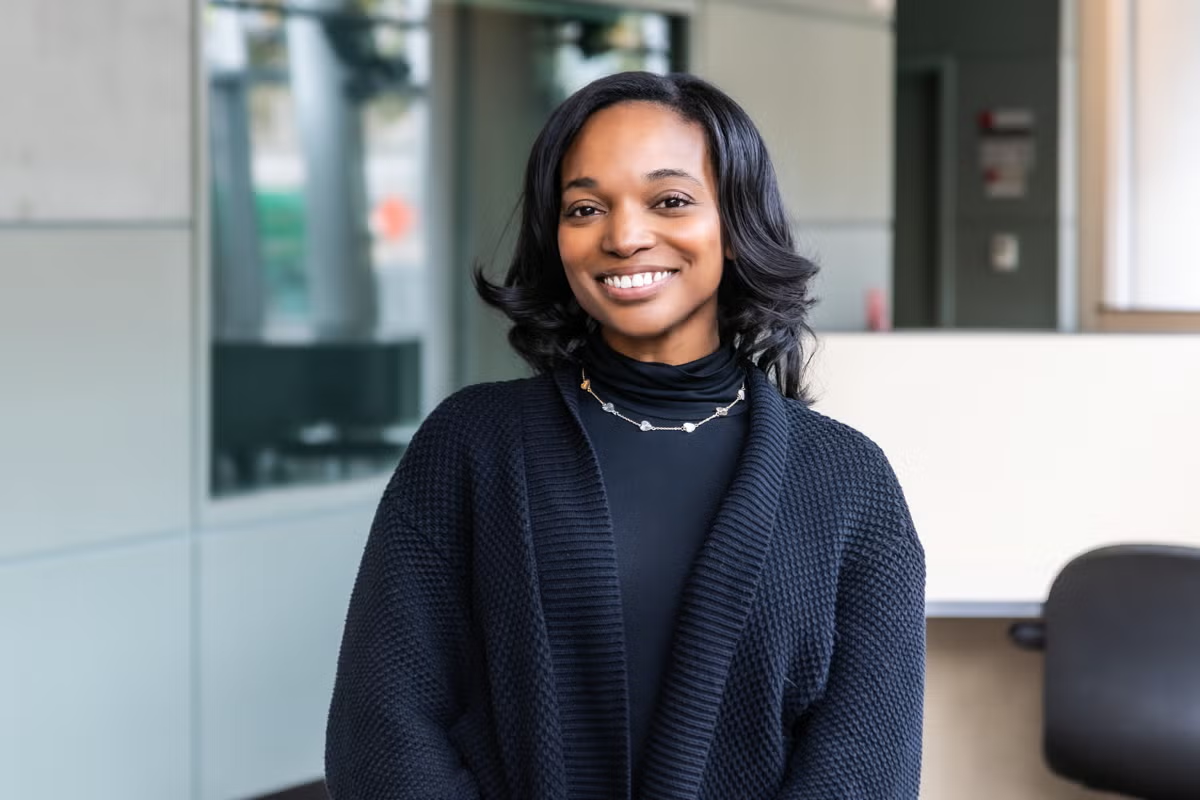
In January 2026, Media, PA, former Councilwoman Joi Washington was inaugurated as mayor of the Borough. Washington is Media’s first Black mayor and first woman mayor; she succeeded longtime Mayor Bob McMahon, who assumed office in 1992. Washington — a freelance graphic designer and illustrator who graduated from Philadelphia’s Moore College of Art & Design in 2008 — advocates for improved public transportation, pedestrian friendliness, and community-strengthening initiatives in Media. The Phoenix sat down with Washington to discuss the first few months in office and her goals for her mayoralty. A transcript of that conversation, condensed and edited for clarity, is below.
Daniel Perrin: You’re now three and a half months into the mayoralty. How has the job been different from what you expected on the campaign trail, and how has it been the same?
Mayor Joi Washington: That’s a great question. It differs in the amount of meeting requests from the community. I wasn’t expecting the amount that I’ve gotten so far. And thankfully, they’ve been very productive.
The things that were the same as what I expected were that I knew that I was going to have a lot of meetings internally with the office, just not externally. I knew I was going to have Council Meetings, of course, and meetings with the Media Borough offices a lot. So that’s been something that I was expecting, and I’ve enjoyed getting to know the employees of Media borough a lot better.
DP: Have there been some big early accomplishments that you’re particularly proud of or that seem notable?
JW: I just did two snow emergency declarations. That’s something that you do as a mayor. With the first one, the snow was here for a while because it was so cold. But yeah, I’m proud that I got to do my recording in Delco Alert and got used to that program. If it’s okay, I’ll let your readers know to sign up for Delco alert. That was really cool to accomplish. I think those are the two notable things, having to do them a month apart from each other is just insane too.
DP: You’ve entered office as the first new mayor of Media since 1992, given Mayor McMahon’s extremely long tenure, and you’ve talked about wanting to continue Mayor McMahon’s legacy and impact on Media. I’m curious though — what do you think were the overall effects, either good or bad or both, of having such a long-term leader on the Media political scene and Delaware County overall?
JW: I think it’s a great thing to have such a lengthy leadership because people got to know Bob in such a personal way as well. I’ve gotten to know him, too. He’s such a good guy. And I think the good thing is that everybody just knows that he’s a good person to confide in. He left a huge legacy by getting the Pennsylvania Veterans Museum in the basement of the Trader Joe’s. When people stop by, they’re like, ‘That’s the most interesting-looking Trader Joe’s,’ and that’s because it’s a building reused. It used to be the Pennsylvania National Guard armory. Using that building and putting two things in there: a museum and a grocery store there is just really cool and unique, and it really shows Mayor Bob McMahon’s interests. Because he was really big on getting the business district back up and running when it wasn’t a big thing when he was coming up as a younger mayor, and I just want to make sure that I continue that and make my connections and get to know people in the business community as much as I get to know them with the residential community as well.
DP: You touched on this a little bit, but in what ways do you see yourself continuing his legacy, and in what ways do you maybe see yourself charting a different path, being that new leadership for the borough? How have you done that already, and how do you hope to?
JW: It’s, it’s always a step-by-step situation. I have a background in the arts, so I definitely want to make sure that I support our arts community as well and do my best to promote the arts events that are happening, like the shows happening in April. That’s going to be the first State Street event of the year. But yes, I think it’s cool having a different background, like Mayor Bob McMahon is a Vietnam War veteran. So you see that with having the Pennsylvania Veterans Museum on State Street as well. You see that inspiration there. I definitely want to make sure that I support the arts, and I’m charting my own path while also supporting the Media businesses, too.
I think how I’m doing that is just getting to know people on a personal level. I’m supporting their events when they have something happening at their own shop and just promoting things through my social media to get more of an audience for them — but then also having that audience stay in town and support the other parts of it. In the end, they’ll be supporting the town by making sure that we can still invest in our our public safety and our cleanliness and our public works department — and keeping our parks up to date and clean and and accessible for people to come and hang out with — and still being an overall great place to visit and a great place to live.
DP: You’ve already served on the Media Borough Council for several years and gotten used to bureaucracy and the slow-moving nature of local government. This is a bureaucracy that is much talked about in the news with the rise of NIMBY politics and in shows like “Parks and Recreation.” What have you learned about how to make meaningful change, even when it often seems like the capacity of local government is restricted in many ways?
JW: I think every time that [NIMBY politics] happens, it’s always difficult, so you have to accept that the change is going to be difficult. Maybe change the framing of something, if possible, and just talk about the benefits of the long-term benefits of something and focus on the big picture, rather than, “Oh my gosh, you’re a NIMBY. Why are you a NIMBY?”
I think what I learned as a council person is that you do have to have a lot of patience. So you take the biggest concerns, and then you figure out the solution. Because otherwise, you just get into like the snowball of going over the same things over and over again. That kind of makes decisions take as long as they do, because you go back and say, ‘Well, what about this? What about that?” Like, we already covered that. Sometimes it is necessary to go back just to make sure that you’re measuring twice, if that makes sense. Compromise is one thing, and then you also have to, at the same time, make sure that things are moving along, just so things don’t take so much of your time and your staff’s time. I just say, do it one day at a time. Try not to get too involved in the nitty gritty of things and just focus on the bigger picture of everything. That’s the best way to endure the slow happenings of local government.
DP: When you say focus on the larger picture and kind of avoid getting caught up in the nitty gritty, do you mean in terms of how you communicate with your residents or how you communicate with people who might be leading a protest movement against a hypothetical new development? What does that look like on the ground?
JW: I think you have to make sure your communication is honest. You want to be authentic and be honest about what’s going on. What you don’t want to do is post all of your thoughts on social media and argue with people on social media, that’s just one thing that is just going to make things a lot worse. I feel like social media really has made things a little bit more difficult, because people can just make up whatever they want. So maybe through official communications, leaders should point out what a town is gaining from this, like a development for example. It’s a shame that throughout the country, senior homes are not even being built because of that type of opposition.
That’s another thing that we have to do: meet people where they are, because a big change is going to be disruptive. You have to be honest and say this is going to be disruptive, and be honest about the timing and you just want to make sure that you’re a good neighbor, in this position too.
DP: On the other side of that narrative of bureaucracy and the slow moving natures of City Halls is a political moment right now where mayoral campaigns and offices have received a ton of attention in the national news. I’m thinking of [Mayor Zohran Mamdani] in New York. I’m thinking of [Mayor Katie Wilson] in Seattle. These campaigns and figures have received attention for their unique style of upbeat campaigning in a political scene that is otherwise exhausting and tiring. Obviously, Media is a completely different town than Seattle and New York in many ways. But I’m curious, given this current political moment, what the overall philosophy you’re looking to approach the office of the mayor is, given the unique abilities and power within politics that mayors’ offices have.
JW: Great question. During my campaign, I made these little buttons saying, choose Joi with kind of a double meaning: “Vote for me, please!” and you want to choose joy when there’s darkness. It definitely was something that I had to choose every single day when I decided to knock on doors, because I did like talking to people, even about their fears because they’re alive in this time. Neighbors are just really worried still about lots of other things that the federal government’s trying to really mess up.
We’re going to try and be prepared — we are a smaller town — and sometimes we lean on the county for guidance. I’m just kind of speaking as myself: our thing is we just want to continue to make sure residents have accessible services like trash, pickup, recycling, compost, making sure that the streets are safe and that they have access to our public meetings. That’s the type of stuff that is boring, but it’s really important for a town or a city to have a functioning local government.
So these issues that are seen as small, they’re actually a big deal. They’re a big deal to keep it going. It shows your tax dollars at work. So we just want to make sure people’s money is used properly and that they also have a good time living here, visiting here, and that’s where the investment goes to. So that’s another reason why people like living here and visiting here: It’s kind of a break from the everyday news of chaos. You do have to choose a positive route. And I just want to make sure I still contribute that to this town, too.
DP: You touched on it a little bit, but how do you see your job as mayor right now within the wider contested political scene in Delaware County and within the divided state government — where the parties divide the different chambers in Harrisburg, leading to a lot of failed negotiations or pretty serious compromises — and within the the chaotic federal government?
JW: I’m still a resident too, and I’m also caught in the middle of this as a taxpayer and as a person in Pennsylvania. I definitely want more things happening in our state government. It’s a shame that things are still not being passed, like the minimum-wage increase, and there are a lot of concerns with there being no more affordable housing. You want to make sure that our streets are safe on the state level too. There’s just so many things that I could go through that I just don’t really have much power to do as a small town mayor, but I think it’s good to be in this position so I can get to know my state representatives much better. I can bring my concerns from my neighbors to them as a representative of this town to let them know that we still care about this and we want to make sure that these issues get addressed. Our state reps do a pretty good job with whatever they have to do within this divided legislature. It really is a shame that things are divided by a couple of seats and that little could bring us more funding, but there’s also the fear of more spending.
I just want to tell them: think about the big picture. How do you see Pennsylvania thriving or not thriving with each idea? But yeah, in my position, I can still be a speaker for a lot of my constituents and just say: “I don’t have much power here, but I can meet with our state rep or state senator and see what they can do within their position.”
DP: You campaigned and won big on a strong platform that focused on affordability and public transportation and issues like that. What are the tools that the mayor’s office and Media has to make tangible progress on those issues? And how do you plan to use those tools?
JW: As long as I am working with my [Borough] council on protecting and keeping up to date with the Vision Zero plan — it got voted on and passed back in June of last year — that will be good. I was really happy to be a part of that when I was a councilperson. I’m still encouraging them, and the council is still very supportive of safer streets and protecting Vision Zero. So the way I would work with them is just ask them: “What’s on the horizon? What are the legislative priorities on that?” And just maybe help them stay focused. I have an excellent Borough Council. So [my goal is to] keep supporting them and all the good decisions that they’re making on Vision Zero and keeping our streets safe.
If they need my assistance with speaking to our representatives, then I’m definitely going to step up and visit them, either here in Media, when they’re at their offices, or in Harrisburg, whenever I can. That’s the same with public transit too. Whenever I’m on State Street, I do notice a lot of people either coming into work, to work at the restaurant or other stores, just taking the trolley in, because they felt like it. I’ve also noticed a lot of older people, too, taking it. I’ll do the same thing for that too. I went to Harrisburg with the Transit for All PA group. We went to Harrisburg and had a legislative day visiting offices. I can do that again in my capacity as a mayor and try to talk to folks. It’s just that issues like that are really hard. We got there, and a lot of the people that we were supposed to talk to were on the legislative floor, and we were not allowed on there. At least we went there, but I’m still open to visiting Harrisburg to meet with our other legislators and to talk about how much it affects a town like Media, and our local small business economy. A lot of people who do work in these offices and in restaurants, they need them. They need reliable transportation. Knowing that owning a car and even buying a car is getting more and more out of reach, transportation is what they rely on. I’m going to plan on asking businesses if there is more assistance that they might need from Harrisburg, so that I can go there and see what I can do.
And with the state reps — I really appreciate them doing this — they provide senior cards for SEPTA to make sure our seniors have those. Those are things that I plan on doing to protect those little things.
DP: You’ve talked a lot about issues of urban planning. And I think what makes Media unique is its density and walkability and diverse local economy in a time when other suburbs seem to be increasingly homogenous, bland, whatever the word you might want to use is. What does it mean for you to be a small town urbanist?
JW: It’s an interesting title whenever I think that, because I’m like, “Was I an urbanist this whole time?” I always gravitated towards neighborhoods that were walkable, and had things closer by rather than needing a car to get everywhere. I’ve lived in those types of suburbs, and I did not like it. I did not like it because it was just so spread out.
Calling myself a small town urbanist just means that I found what I like in this community — this type of close-knit bonding is really good for me. I think my neighbors like it. I think a lot of people really find that to be unique, especially if they’re visiting from a place that’s not as close-knit like this. When you look at older photos of Media, you just go like, Oh, wow, that close bond is still there. And I think the care that has been invested and done to the older buildings that you might see on State Street and throughout town, just so they can still exist, is pretty impressive. So then you see these places that still have shops going into this place that used to be an armory, for example. And then you see homes here, like the old Victorians, that are broken up into apartments. It’s a great way to show that the character in Media has always been protected. I’m really excited to see where it goes next.
DP: How do you hope Media continues to protect against some of those pressures, like corporate concentration, for example?
JW: That’s gonna be hard. That’s something else to go to Harrisburg about.
The corporations are buying up houses just to rent them out, so regular home buyers cannot compete with those prices. It’s unfortunate. I know somebody who put down some money on a house nearby, and then a developer wanted to buy the property, so they outbid them by $1,000 or $2,000 just so they could get it and then rent it out. You want to make sure that people can actually compete, and it’s getting more impossible by the day. I’m hoping that I can raise issues with my state reps on that too, and, and also with my council members, because while we can only do so much, [but] as long as we keep communicating, [then] we [can] take care of stuff in the town. If you want to escalate it to a state issue, then we can forward you to Jenn O’Mara, our state rep, or Tim Kearney, our state senator. And I think it’s also really important to keep those positive relationships that we have with our state reps there, just so they can help us out with that too.
DP: On public transportation, specifically, I think a lot of Pennsylvanians became more aware of its importance and the nuances with how it’s governed with the political saga over state funding for SEPTA last year. What did that saga reveal to you about the current state of Pennsylvania politics and what is needed for more responsive governance in the future?
JW: What it really showed is that people just need to listen to the riders and operators a lot more. With respect to the advocacy groups I got involved with on my own time, I think they did a great job with getting attention focused on the issue. Because for a long time, there just wasn’t enough attention on it. And then there’s this expectation that “Harrisburg is going to Harrisburg, who cares about that,” and unfortunately, SEPTA, for example, just kind of takes on the brunt of it.
But I also feel like transportation agencies can be a little bit more honest about safety. I think that in some places, some people don’t really want to talk about safety and then they give into the right wing framing of it. But, if you just talk, if you just listen to ridership, it’s more of an understanding of a rider’s experience, rather than the left or right angle, because unfortunately, that type of stuff really just stops all progress. I think a lot of the demonization of riderships and of people who are struggling with drug addiction and homelessness, they get targeted as, “Oh, they’ve ruined public transit. It’s their fault.” But, rather, it’s a lot of other things, and we can address those problems. Get these people some help. It’s more of a connected problem. It’s not just about public transit at that point. It’s about what cities and counties are going to do to expand their shelters and homes and legalize housing. Then you also have the hospital shutting down, which makes it even tougher for people who are struggling with addiction.
I feel like folding more issues into public transit might be helpful, just so people understand the full picture of how all those issues interact with each other. And, yeah, I think money is the root of all evil. You see people saying, “Yes, you know this thing costs money.” And it’s the truth, things cost money. We can’t say that everything’s going to be free and then expect that the people who operate the buses, trains, and trolleys will just do that for free. So I think we should have more of a financial conversation about where the money goes and show some regard to who keeps SEPTA moving. So yeah, that saga was a big eye opener.
I know people don’t want to make it political, but it is political. You have to vote for people who care about these things that improve your life, and if public transit improves your life, you have to vote for people who care about that, especially at the state level.
DP: Swarthmore and Media have a special relationship, given the easy access between the two on the Media-Wawa line and Media being the closest place for Swarthmore students to find the resources and offerings of a lively, grid-streeted town. How do you view the relationship between Media and Swarthmore College, and what are some of that relationship’s pros and cons and nuances?
JW: I appreciate the closeness. I think it’s really cool that we are that close. I was on the Media-Wawa line with my husband once and we noticed some kids who got on at Swarthmore and they were walking into town just to go to dim sum. So I thought that was really cute. I really like that there was something for Swarthmore students to visit in Media.
I think there’s a new mayor in Swarthmore now, so things are changing over there. I would like to develop a relationship with the local government there and just say, “Hey, this is really cool,” and support their events, if possible.
I would like to talk to people and get to know about it some more and see how we can make it into even more of a positive working relationship.
DP: What do you hope to see from either the college’s leaders or the college’s students in the coming years?
JW: That’s a good question. If you want to volunteer for some of our events in town, please reach out to us. You don’t have to be a resident to volunteer, especially for Visit Media events.
We would love to see people here. Let us know what we could do better. If you’re visiting, we always want to hear some constructive criticism.
DP: Any parting words for the Swarthmore community?
JW: Keep fighting the good fight. That’s all I can say. Thank you so much for inviting me to this.


