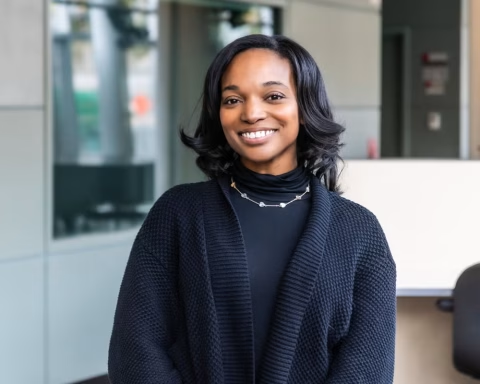
Swarthmore Fire Department Chief Conlen Booth became mayor of the borough on Jan. 6, 2026, having received the endorsement of the Swarthmore Town Democratic Committee in February 2025. A lifelong Delaware County resident, Booth began volunteering with the fire department over 25 years ago, when he was a junior at the local Strath Haven High School. On March 6, he sat down with The Phoenix to discuss his experiences in office, his memories of the college’s past, and his outlook on the relationship between campus and borough residents. A transcript of that conversation, condensed and edited for clarity, is below.
Experience as Mayor
Zephyr Weinreich: The date of this interview marks exactly three months since your inauguration. How have these first three months been? So far, has your work as mayor aligned with the expectations that you’d had about the job?
Conlen Booth: So, obviously, there are multiple parts to that. Is it what I expected? I don’t think I even knew what to expect, so, simple answer: not necessarily. It has been wildly fascinating and a great opportunity to learn.
I’ve learned more about local governance in the last few weeks than I ever knew. It’s one of those unique things where, as you peel back the layers, you’re like, “Oh, I didn’t even realize that we had to handle whatever that detail was.”
Sort of by happenstance, it happens to be one of the busiest times of borough involvement in zoning in particular. Zoning is something that I never really understood. I’m not specifically engaged in all of those conversations, but I’m learning a lot about some of the higher-level issues that go into it and all of the considerations that it requires.
There’s been the process of a new restaurant opening in town. And so, you know, the liquor license, the stuff that already happened to the buildings, the different facets of maintaining the processes that need to be in place.
ZW: Have there been any particular challenges?
CB: It’s now public knowledge that we had to terminate the borough manager, which is a difficult thing and unfortunate. Nobody wanted that, and so now working to ensure that there are no lapses in governance, making sure that nothing’s missed and that all of those important functions are occurring, is definitely hard.
I’ll give you a fairly simple example: we had the snowstorm. When that happens, we need to make sure that public works has everything they need for plowing the streets and for salting, and we need to make sure that we’re in communication with the trash vendor who comes and picks up all the trash in town, who may not be able to do that during a storm.
So those were things that our borough manager and the staff in the office handled, but all of the council members and I stepped in to make sure we were helping to ensure those things were happening and no issues arose. To everyone’s credit, that happened.
ZW: Many of our readers may not have a clear sense of the responsibilities and powers that the borough mayoralty entails. Could you walk us through a day in the life?
CB: I’m still learning because it’s only been a few weeks, and, unfortunately, I was under the weather for some of that time because I had surgery on my spine. I think the role of the mayor can be as much as someone decides it should be. I think there’s a great impetus on any mayor: where it is on me to make sure that I’m engaging with activities and being available to people.
As for an average day in the life, there are days when I don’t get any emails, or I’m not even in the borough office, but there are also days when I end up having multiple meetings in a day. I had one earlier this morning and one this afternoon. And that’s on a day when the borough is technically closed, but it’s just the day that people wanted to meet.
Yesterday, I got the chance to get coffee with Representative [Jennifer] O’Mara, who represents Swarthmore along with other municipalities. She wants to set up meetings with all the mayors within the towns that she represents, which I think is fantastic. So those types of opportunities will come up, but it’s not an everyday thing.
You know, once I got cleared from surgery, I had about 22 emails from people in town that were raising concerns or asking questions, so I was just going through them. But now, it’s been a couple of days, and I don’t think I’ve seen any email from anyone other than regular business concerns.
The interesting piece of all this is that all the council roles, including the mayor, are volunteer positions. So it’s not Monday through Friday, 9 a.m. to 5 p.m. It’s about being engaged, working with people, answering questions when you can, and ultimately being a part of the fabric that holds the town together. That’s how I’m seeing it as of now, at least.
Relationship With Swarthmore College
ZW: You grew up in the Swarthmore area, meaning that, in addition to your more recent professional interactions with the college, you must have memories of campus from earlier in your life. How did you view Swarthmore College as a child and young adult? How has that relationship evolved over time?
CB: I’ll take you through a couple of periods. I grew up in Nether Providence, and it’s interesting because as a younger kid, the college was just sort of this abstract thing: you knew it was over there, but you didn’t interact with it. My parents didn’t really take us there unless we were going to the arboretum for a picnic or something like that.
The [local] high school and middle school were a little bit more engaged [with the college]. There were opportunities to visit the campus beginning in middle school. That was a long time ago. But then I’ll fast forward a little bit to near the end of high school, which is when I joined the Swarthmore fire department.
When I joined the fire department was when I truly gained an appreciation for the college. I don’t know if you guys know this on campus, but back when I was in high school, probably 60% of the department was Swarthmore College students, and we had over 100 members who were active. It was an entirely volunteer department at the time; there were no staff like today. We now have some staff, because we just don’t have enough volunteers, but when I joined, the gross majority of members were Swarthmore students who went to fire school, went to EMT school, and volunteered. And when the horn would go off, which I think you guys now call the angry moose —
ZW: The Fire Moose?
CB (laughing): The Fire Moose — that’s right. So when the horn would go off, you would see twenty to 30 students just running down the hill through town. It was a sight to see. And it was such a formidable time in my life. So that’s a big part of what I remember.
Also around that time, I started dating one of the students who was a volunteer here at the station, and so I spent even more time on campus because of her. She lived in [the off-campus housing building] the Barn, so I spent time there, and we went to different buildings for her classes. I remember finishing high school and thinking, “I wish I was smart enough to go to Swarthmore College.”
I vividly remember sitting with her in one of her classes, and it was out on the lawn under a tree. I was sitting with her and thinking, “this is what college is going to be like for me.” And my college was nowhere near that. I unfortunately went to a city college. I went to the University of Pittsburgh, which was not really my first choice, but economically, it’s where my parents pushed me to go. But that period at Swarthmore was a special time in my life. We had this real camaraderie, all of the firehouse volunteers from the town and the college.
For a lot of reasons, we just don’t get many student volunteers [at the fire department] anymore. I wish that there was a way that we could do a better job about this as a borough in general — switching back to engaging the student body, getting them more involved. It would be great, whether it was through creating intern positions or building projects and soliciting students to come and work on some of those. I think it would be an amazing thing for us to do. I’d love it if we got more people to come down to the firehouse, but the time commitment for training and the level that’s required have increased. Obviously, school being difficult and taking a lot of time for people makes that hard. But the college holds a very special place in my heart.
ZW: More broadly speaking, how would you characterize the relationship between the college and the borough?
CB: I think there are two answers to that question: one is the relationship with the college leadership, and one is the relationship with the college students. They’re similar in some ways, but also really different in others.
I think the relationship between the borough and the college is very good. It’s one of those unique things because the college exists within the borough, but it is its own entity. But I find — and this is just the snapshot of the two-and-a-half-month period of me being mayor — the college leadership is very collaborative. They engage with us even when they don’t have to. They go out of their way to ensure that we’re working together and that we’re all working towards common goals.
Unfortunately, I was actually supposed to meet with [Swarthmore College President] Val Smith, and I couldn’t attend the meeting because I was having surgery. Hopefully, we’ll do that soon. But overall, I think that relationship is very, very good. There’s always room for improvement in any relationship, but I think it’s very positive.
ZW: And the relationship with the student body?
CB: I don’t think it’s bad, but it’s a lot more nebulous because there’s not one or three or six people to talk to as a student body. It’s much broader. Again, what I would love to see is more engagement, and that’s two-sided, right? It’s up to the student body and then back to us. At our council meeting this past Monday, I think two or three students came down to speak, which was great. And our council president made a really poignant note of thanking them and saying that it’s really rare that we get students to come down and engage, and we really appreciate them taking the time.
I think that’s one of those things that broadly, I wish would improve. I was a college student living in a town that isn’t where I grew up before, so I recognize that for a lot of people, there’s not a significant desire to get engaged at a local level because it’s finite; you’re going to leave at some point. So it’s important that we find specific projects, and then we say, “Hey, do you want to come help with this?”
ZW: As you probably know, President Smith recently announced that she’ll be parting ways with the college in June of 2027. What would you like to see from her during the remainder of her time at Swarthmore? What would you like to see from her successor?
CB: That’s a little hard to answer, only in that I have not yet met her, so I haven’t had the opportunity to really engage in that way. But broadly speaking, what I would like to see is more involvement. This is going to sound more critical than I mean it to: the president is running an organization, and rightly so. Her focus is on the organization and not as much the town, and so our interactions (again, this is a finite period of time so far) have been very limited. We only had that one meeting set up, and I couldn’t attend. And that’s on me. But I think that having more frequent interactions, collaboration, and engagement on things would be positive for everyone, because anything the town does affects the college, and much of what the college does affects the town.
As for the next leader, it’s sort of twofold. Selfishly, I want someone who is available to meet regularly, whether there’s an issue to talk about or not, just so that we’re on the same page. And then the other side is that I want someone who will continue what the college is doing and build on it. I think there’s a lot of potential at the school to do amazing things. I’m personally biased because I had spent some time up there, and getting to see it through the lens of the other students who were my compatriots at the time helped me to really understand how special of a place it is.
I still lament, a little bit, the fact that I didn’t go to a school more similar. Swarthmore has the mentality of allowing people to develop their own path. One of my good friends was a Swarthmore student who actually became a paramedic and worked with me in Upper Darby as a paramedic after school. He built a major that was the most ridiculous major I’ve ever heard of. It was classical oboe-ism. He was able to build out and design an education around things that interested him. And I think that is one of the most spectacular things. So I would hope that they find someone who maintains that environment of free thinking, but also sees the benefit of helping to get the students to engage locally, because there’s so much potential. It could be really beneficial to help make the town even more vibrant.
And, you know, neither institution — the town or the school — is going anywhere. There’s nowhere for them to go. So it’s just about asking how we grow that symbiosis even more.
On the Election
ZW: Last year, The Phoenix reported on a local controversy sparked by the Swarthmore Town Democratic Committee’s endorsement of your campaign. Since the borough is predominantly left-leaning, the Democratic primary effectively decides the election; in turn, the Committee’s endorsement effectively decides the primary. After you received the Committee’s formal support, your opponent in the primary, Borough Council Member Kristen Seymore, told The Phoenix that she was concerned about the implications of the endorsement process with regard to local democracy and transparency. Others have echoed Seymore’s sentiments, arguing that the Committee should provide information about candidates without recommending any candidate in particular. Borough Council President Jill Gaieski, meanwhile, asserted that the endorsement process is a crucial means of helping voters to assess potential leaders. What are your thoughts on this debate? Do you believe that the endorsement process should continue to exist as it has in the past?
CB: I struggle with it. I’ll go back a little bit and say this: I have never been a political person. I’ve been in emergency services my entire life, and in my opinion, emergency services must be apolitical. The fire department can’t be a Republican fire department or a Democratic fire department. So it was all new to me. I have always been an independent up until I was asked to run [as a Democrat] and encouraged to change my affiliation, which was not an easy thing for me to decide to do. But I talked with other mayors and other elected people before I made the decision, because I wanted to understand more about the roles and more about how I could get involved and what I could do that could benefit the town.
But I feel like politics is a weird animal, and the endorsement process was unfamiliar to me. So I was having a portion of this conversation yesterday with [Representative] O’Mara. We were talking about the primaries that are occurring right now across the country. I was saying that, to be honest, I feel fundamentally in my heart that the two-party system is flawed. I was really fascinated that she said she agreed with me. So she goes, “I was an independent too, but you can’t change it unless you get involved in it.” That’s really how I ended up where I am because, you know, I can either be frustrated with it from the outside or I can engage and try to do things.
So as for the endorsement, that’s sort of where I land. I see the benefit, but I also understand the concern. I think that generally, people are uninformed when it comes to who they’re voting for. Unless it’s a large election where there’s all this money funneled into advertisements and public debates and blah, blah, blah, and that doesn’t happen at a local level. And so — is there a way to reliably allow everyone to understand who a candidate is and make an informed decision outside of those Democratic or Republican primary and endorsement processes? I don’t know. And there are benefits to it. You have a small committee made up of people in the community, and they essentially vet candidates. They meet with them, ask them questions, and determine if they think they will be the right person to foster certain things forward or steward things appropriately. But, you know, is it representative enough of the people? That’s a hard question to answer.
ZW: Do you have any parting words for our readers?
CB: The last message I would say is: I really encourage the students to get involved and engage, even if it’s not in specific governmental items that are up for debate in a council session. If there’s projects or thoughts or questions, I encourage people to come down and get involved and ask questions.